
FOUNDATIONS:
Centering Writing in Education and Public Life
Fashion Institute of Technology, SUNY will host our next conference on November 6 and 7, 2026 in New York City.
Please view the Call for Proposals for detailed submission guidelines.
Proposal deadline extended to September 8, 2026:
2026 marks the 250th anniversary of the United States Declaration of Independence, offering an opportunity to reflect on the importance of literacy, communication, and civic participation in public life. This year’s SUNY Council on Writing conference invites you to consider writing as a foundational practice for education and public life, a vehicle for shaping meaningful intellectual and civic engagement. Across disciplines and contexts, writing supports transfer of knowledge by helping students participate in ongoing conversations, reflect on learning experiences, and adapt their knowledge to new situations. Through writing, students develop critical, rhetorical, and communicative competence that is foundational for academic success, civic participation, and lifelong learning.
Indeed, we are in precarious, changing, controversial, crucial times. Writing is under a huge shift in our colleges and in our society. Undoubtedly, this shift in writing and ideas is changing how we teach, discern, and disseminate information into the world. In turn, we have changed how we “see” one another. But, at this moment where does that leave us with our students, in our classrooms, and in our research and teaching pedagogy? As the nation commemorates and grapples with America250TM, memory, collective writing, and histories will be remembered and celebrated in myriad ways. Writers and educators hope to seek truth over power, and in the end, we invite you to consider what we leave for later generations to study.
We welcome proposals from across the region and nation that explore one or more of the following topics:
- Writing and knowledge transfer: How can we design pedagogies and curricula that support students’ transfer of foundational learning for success across and/or beyond general education courses?
- Civic discourse and AI literacy: How can writing and writing instruction advance democratic discourse and participation amidst rapid technological change?
- Academic momentum and developmental education reform: How do we help students to build foundational literacy skills while progressing through gateway English courses?
- Writing as an ecology: How do people, technologies, policies, and institutions collectively shape writing practices and learning experiences? What can ecological approaches reveal about the role of writing in knowledge transfer, civic participation, and AI literacy?
- Writing and equity: How can writing instruction support multilingual learners and promote linguistic justice, inclusion, and equitable access to learning?
- Writing and information literacy: How can writing instruction help students critically evaluate information and make informed decisions in an increasingly complex information landscape?
- Writing and community engagement: How can writing connect students to local communities, public audiences, and real-world issues? What role does writing play in fostering civic and community participation?
- Writing centers, tutoring, and student support: How do writing centers, peer tutoring programs, libraries, and academic support services contribute to literacy development and student success across the curriculum?
- Writing and Voice: How does writing create the tenets and foundational knowledge for self-advocacy and interpreting the challenges of our ever-changing world and humanity?
Registration, travel, and lodging information can be found below. For more information, please contact brian_fallon@fitnyc.edu.
Pre-Conference Workshop Leader and Keynote Speaker
Tom Deans, PhD, Professor of English and Director of the Writing Center, University of Connecticut
Tom directs the University Writing Center at University of Connecticut where he supports writing across the disciplines, teaches undergraduate and graduate courses, and pursues research interests in writing studies, writing across and beyond the curriculum, writing centers, prose style, and representations of writers in literary and sacred texts. In recent years he’s been series editor for theOxford Brief Guides to Writing in the Disciplines, done a Fulbright to support emerging writing centers in East Africa, and collaborated on an NSF-funded initiative on science writing and neurodiversity. A thread that weaves through his work is an emphasis on writing as a mode of social action.
Registration Information
Registration is now open for the 2026 SUNY Council on Writing Conference. To register, please visit https://fit.nbsstore.net/suny-council-on-writing.
Early-bird Rate until October 15, 2026:
- $85 Full-time Faculty, Administrators and Professional Staff
- $60 Part-time Faculty and Professional Staff
Regular Rate beginning on October 16, 2026:
- $95 Full-time Faculty, Administrators and Professional Staff
- $70 Part-time Faculty and Professional Staff
Cancellation Policy
- Early cancellations: Full refunds are available until October 23, 2026.
- Mid-window cancellations: 50% refund October 24 – November 5.
- Late cancellations: No refunds after November 5.
Lodging and Travel Information
Several hotels near FIT offer FIT preferred rates: https://www.fitnyc.edu/admissions/visit/getting-to-fit/preferred-hotels.php
Sometimes you can find excellent lodging options using a travel site. Because FIT is conveniently located and easy to get to, you might want to expand your lodging search beyond the FIT preferred hotels.
If you prefer to stay elsewhere in the city, you can get to FIT’s campus by taking the 1 or the N, R to the 28th Street Station. Alternatively, take the C, E, or F to the 23rd Street Station or take the 1, 2, 3, A, C, E, D, F, N, or Q to the 34th Street Station.
Please visit the “Getting to FIT” website for more information on getting to FIT by public transit, train, air, or by car.
Past Conferences
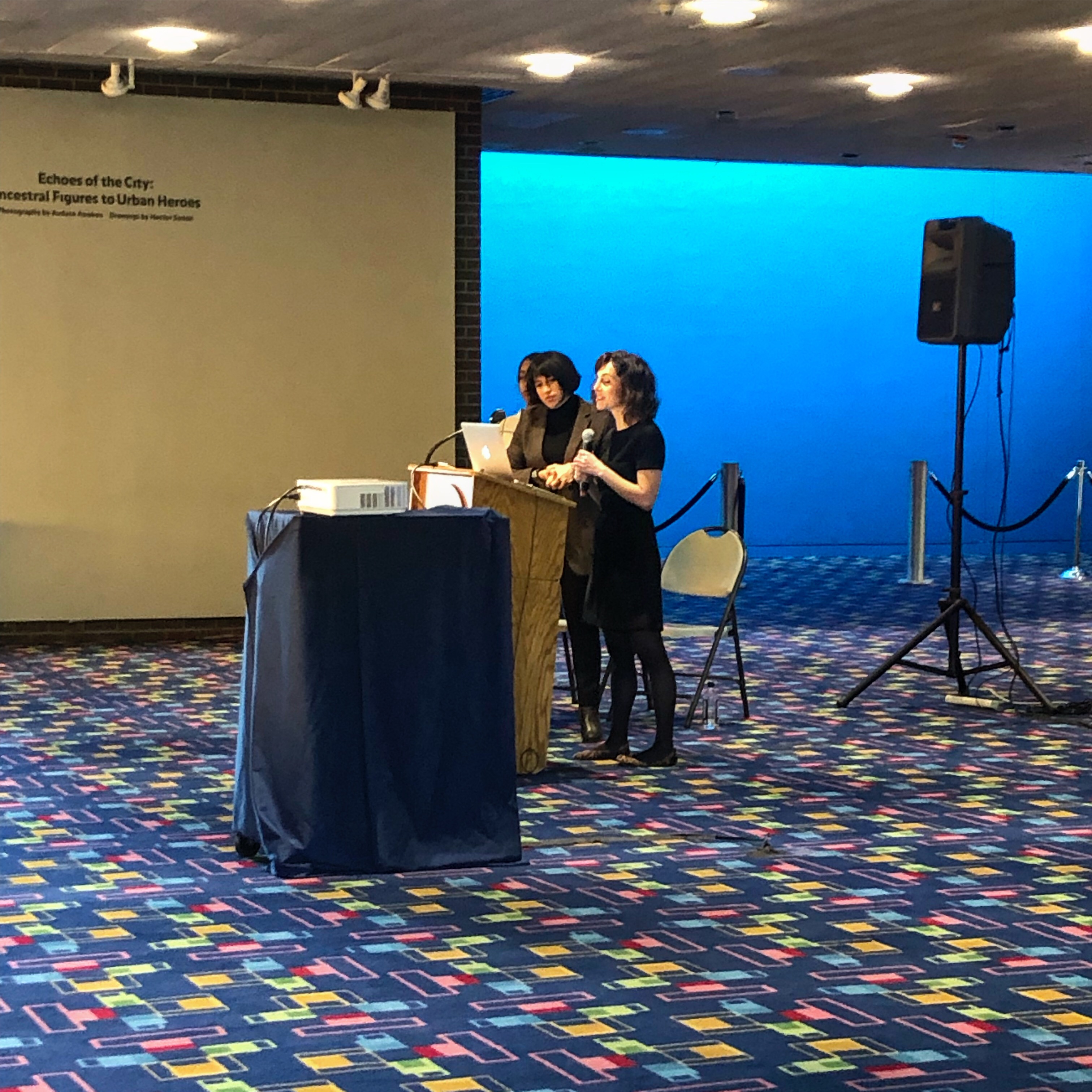
2023: “Writing, Thinking, and Learning with AI: Exploring Relationships of Rhetoric and Artificial Intelligence.” Hosted by the Program in Writing and Rhetoric at SUNY Stony Brook and the SUNY Council on Writing.
2021: “Scarcity and Abundance: Cultivating Community and Expertise in Uncertain Times.” A virtual conference hosted by the SUNY Council on Writing.
2019: November 8-9, Purchase College, NY. “The Art of Writing/The Writing of Art.”
2018: October 19th and 20th, Farmingdale State College campus, Farmingdale, NY. Theme: “Why Writing Matters: Articulating the Value of Writing to Students, Administrators, and Faculty from Across the Disciplines.”
2017: Onondaga Community College. Theme: The theme for this year’s conference will be “Defining Success in College Composition: Rethinking Writers, Writing, and Pedagogy.”
2016: University at Albany. Theme:“Writing (and) Affordability.” Keynotes: Tamika Carey, Eileen Schell.
2014: Onondaga Community College. Theme: “Transitions: The Changing Landscape of Higher Education.” Keynotes: Cheryl Ball, Tony Scott.
2013: University at Buffalo. Theme: “Building Cultures of Writing for Tomorrow.” Keynote: Richard Miller.
2012: Fashion Institute of Technology. Theme: “Sustainability and Writing.” Keynote: Amy Kimme Hea.
2011: Binghamton University. Theme: “Building 21st Century Writing Programs: Literacy and Leadership in the New Millenium.” Keynotes: Lynne Bloom, Kurt Spellmeyer.
2010: Plattsburgh. Theme: “Teaching Writing for Social Justice.” Keynote: Nancy Welch.
2009: Buffalo State. Theme: “Writing Program Identities.” Keynote: Elizabeth Wardle.
2008: Stony Brook. Theme: “Inevitable Intersection: Writing at the Crossroads of Public and Private Discourse in the 21st Century.” Keynote: Sondra Perl.
2007: Albany. Theme: “Writing in an Age of Assessment.” Keynote: Peter Elbow.
2006: Oswego. Theme: “Words of One’s Own: Plagiarism, Citation, Textual Ownership, and Academic Integrity.” Keynote: Rebecca Moore Howard.
2004: Adirondack Community College. Theme: “Writing Across and Beyond Institutional Borders.” Keynote: Eileen Schell.
2003: Suffolk Community College. Keynotes: Kathleen Blake Yancey and Doug Hesse.
2002: Jefferson Community College. Theme: “Energizing Teaching, Writing, and the Teaching of Writing.”
2001: Alfred State. Keynote: Pat Belanoff.
1999: SUNY Potsdam.
1998: Genesee Community College.
1997: Suffolk Community College. Theme: “Teaching Toward the 21st Century: Where are We Going? Where Have We Been?” Keynote: Kathryn Gottschalk.
1993: Niagara Community College. Theme: “Exploring Complexities.” Keynote: Chris Anson.
1992: SUNY Institute of Technology Utica/Rome. Theme: “Creating a Community of Writing.” Keynote: Cynthia Selfe.
1991: Westchester Community College. Theme: “The Right to Literacy.” Keynote: James Slevin.
1990: Buffalo State. Theme: “Issues in the Teaching of Writing”; keynote speaker: Alan C. Purves; 22 articles in the published Conference Proceedings
1989: Farmingdale.
1985: Brockport.
*Note: Our records here are incomplete. If you have information about what’s either missing or inaccurate in this list, please let us know!

